 We’ve posted a tentative development roadmap for 2026 over on Github. We’ve got lots of exciting things planned through the year and major features across just about every facet of QUADS.
First let’s look at some pictures!
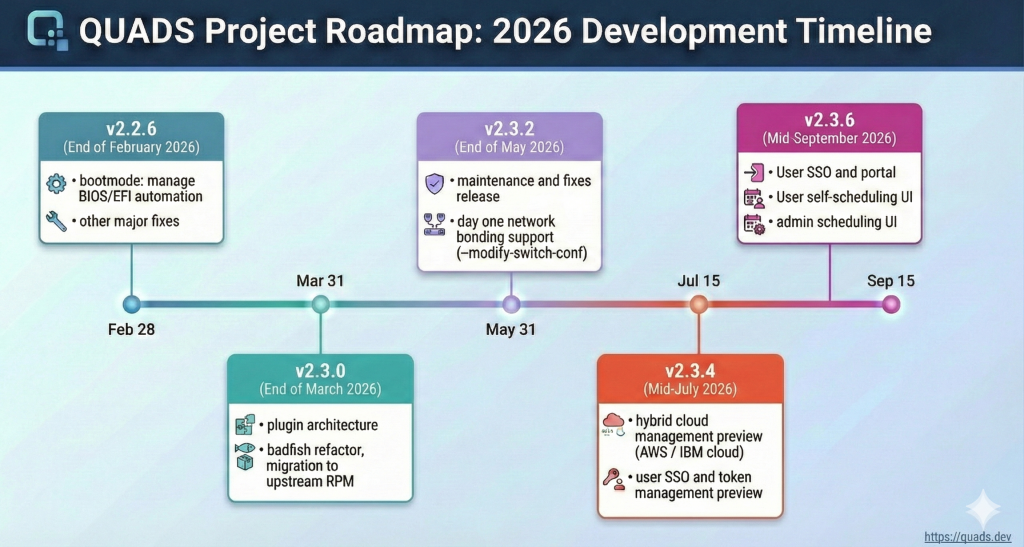
Let’s dive into the details, everything is tentative even the dates but this should give you a much better idea of where development is headed into 2026.
QUADS Project Roadmap: 2026
This roadmap outlines the progression from infrastructure hardening (BIOS/EFI) to architectural flexibility (Plugins), followed by a major expansion into Hybrid Cloud and User Experience (UI/SSO).
Current Status: v2.2.4 (Released 2026-10-30)
| Version | Target Date | Key Focus | Primary Deliverables |
|---|---|---|---|
| v2.2.6 | Feb 28, 2026 | Infrastructure & Automation | bootmode automation (BIOS/EFI), Major bug fixes |
| v2.3.0 | Mar 31, 2026 | Architecture | Plugin Architecture implementation, Move to Badfish upstream Fedora RPM and library |
| v2.3.2 | May 30, 2026 | Stability & Network Automation | Post-feature maintenance, regression fixes, day 1 network port bonding via --modify-switch-conf |
| v2.3.4 | July 15, 2026 | Hybrid Cloud & Security | AWS/IBM Cloud preview, SSO/Token preview |
| v2.3.6 | Q3 2026 (Est.) | User Experience (UX) | UI Phase 2, Self-scheduling, Admin Portal |
Detailed Milestone Breakdown
v2.2.6: The Infrastructure Update
- Target: End of February 2026
- Theme: Deepening hardware control.
- Key Features:
bootmodeAutomation: Introduction of full lifecycle management for BIOS and EFI states. This removes manual intervention for switching boot modes, critical for automated provisioning workflows.- Major Fixes: Accumulation of stability patches post-2.2.4 to prepare the codebase for the 2.3 architectural shift.
v2.3.0: The Modular Shift
- Target: End of March 2026
- Theme: Extensibility, Design Simplification.
- Key Features:
- Plugin Architecture: Decoupling core logic from extensions. This is a pivotal release that allows community and enterprise users to write custom scheduling or provisioning logic without forking the core QUADS codebase.
- Badfish Refactor and Migration: Removing and refactoring codebase to use the upstream Badfish RPM once it is accepted and available into Fedora project upstream.
v2.3.2: Stabilization Phase with Network Features
- Target: End of May 2026
- Theme: Reliability.
- Key Features:
- Maintenance: Specifically targeted at stabilizing the new Plugin Architecture introduced in 2.3.0.
- Tech Debt: Address any regressions found during the 2.2.x -> 2.3.x transition.
- Network Automation: Enhance
--modify-switch-confto allow day one, custom per-port bonding configurations and formove_and_rebuildto roll them back properly.
v2.3.4: The Hybrid & Security Preview
- Target: Mid-July 2026
- Theme: Expansion beyond bare metal.
- Key Features:
- Hybrid Cloud Preview: Initial support for provisioning and managing resources on AWS and IBM Cloud alongside local hardware.
- Auth Preview: Implementation of User SSO and Token management backend. This lays the groundwork for the secure multi-tenant UI coming in the next release.
v2.3.6: The User Experience Overhaul
- Target: Estimated end of September or Q3/Q4 2026
- Theme: Accessibility and Self-Service.
- Key Features:
- UI Phase 2: A major frontend update leveraging the new APIs.
- User Portal: Full integration of the SSO backend (from 2.3.4) allowing users to log in, view and manage scheduled assignments, and self-schedule resources.
- Admin Scheduling UI: A graphical interface for administrators to manage the queue and resource allocation, replacing CLI-only workflows for common tasks.
Strategic Observation
This roadmap demonstrates a clear maturation curve for QUADS:
- Q1 2026: Solidifying the “Metal” layer (BIOS/EFI).
- Late Q1 2026: Opening the “Logic” layer (Plugins).
- Q2 2026: Expanding the “infrastructure” layer (Hybrid Cloud, Network Bonding).
- Q3 2026: Polishing the “Human” layer (UI/UX).
 QUADS Project